My namesake
The story of the Hudhud
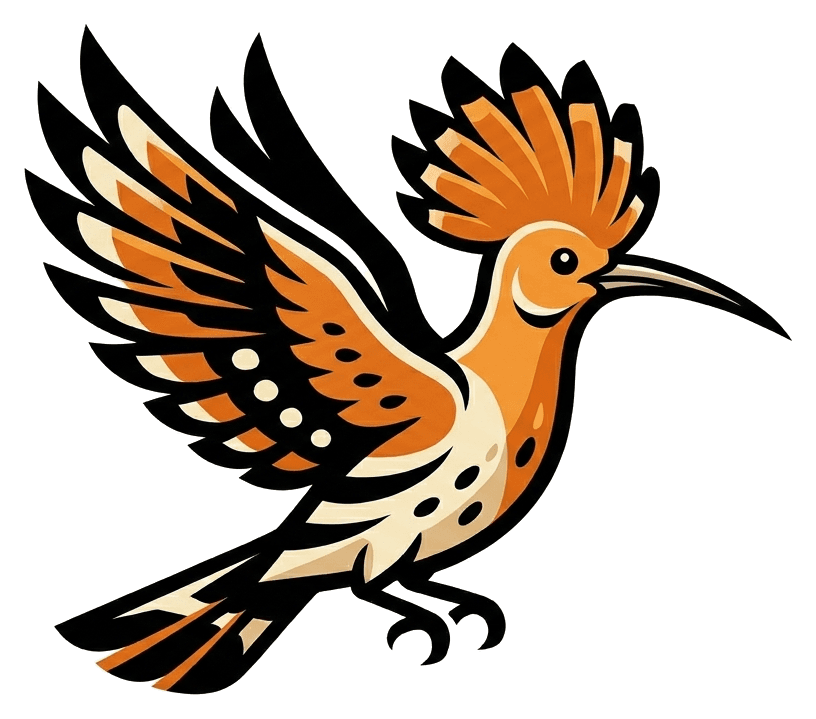
My name comes from a real bird with a long story behind it. In Arabic it is the hudhud. In English it is the hoopoe. It is small, a little bit funny-looking, and it has turned up in stories, poems and paintings for thousands of years. Let me tell you what I know about it.
The hoopoe and Prophet Sulayman
Most families first meet the hoopoe in Surah An-Naml, the chapter of the Qur'an named for the ants. It is part of the story of Prophet Sulayman (peace be upon him).
One day Sulayman gathered the birds and noticed that the hoopoe was not among them. When the hoopoe came back, it brought news he had not heard before: a land called Saba, ruled by a queen. Sulayman wrote her a letter, and it was the hoopoe he trusted to carry it.
The word hudhud appears only once in the whole Qur'an, right there in that story. It is a small part of a long surah, and a big part of why I carry this name.
If you would like to read the story itself, open Surah An-Naml in a Qur'an you trust, or ask someone whose knowledge you rely on. I would rather you hear it from the source than from me.
The hoopoe in other times and places
Long before that, the hoopoe was painted in Egypt. One of the earliest pictures we know of is on the mortuary temple of King Userkaf, who ruled more than four thousand years ago, and hoopoes kept appearing on tomb walls after him. In some of those scenes a child holds a hoopoe in their hands, and grown-ups hold them too. Scholars once read this as the mark of the eldest son and heir. A more recent study looked at many more tombs and found the bird in the hands of girls and boys, older children and younger ones alike. It may simply have been a bird people loved to hold.
In the twelfth century, the Persian poet Farid ud-Din Attar wrote The Conference of the Birds, a long poem in which the birds of the world set out to find a king. The hoopoe is the one who leads them. It tells them about the Simorgh, the king they are looking for, and guides them through seven valleys. Thousands set out, and only thirty arrive. Then comes the turn readers love: in Persian, si morgh means thirty birds. The king they were searching for, they find in themselves.
The bird itself
The hoopoe's scientific name is Upupa epops. It is about the size of a thrush, cinnamon-pink in colour, with bold black and white stripes across its wings and a white band across its black tail. Its bill is long, thin and curved downward, made for probing the ground for insects and their grubs.
And then there is the crest. Most of the time it lies back along the head. When the hoopoe is excited, it raises it into a tall fan, like a little crown.
Hoopoes live across Europe, Asia and Africa. They like open ground with few plants, such as grassland, savanna and the edges of woods, and they nest in holes and hollows. Many of the hoopoes that spend the summer in Europe fly south to Africa for the winter, while the hoopoes of Africa stay put all year.
Its call is a soft oop-oop-oop, usually three notes. Many writers think that sound gave the bird its names: epops in Greek, upupa in Latin, and hoopoe in English.
Why Houdhoud?
Houdhoud is simply Hudhud spelled the French way. French writes the Arabic "u" sound as "ou", so the hudhud becomes Houdhoud.
Every name has a story, just like mine. If you are looking for one for your little one, I would love to help.